Custom AI Software vs Off-the-Shelf Tools: Which One Should a Service Business Use?
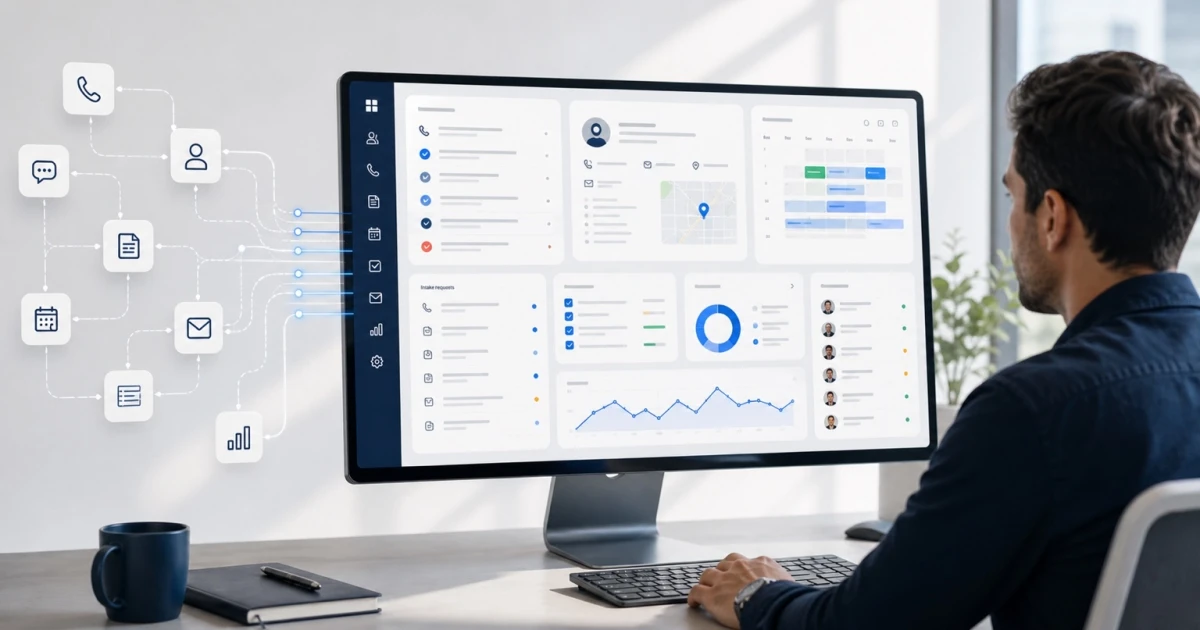
The choice between custom AI software and off-the-shelf tools is not really a question about brands. It is a question about whether your work can keep moving through apps that do not talk to each other.
Every service business runs on a handful of moving parts: the phone, the contact form, the CRM, the calendar, the follow-up, and the reporting that tells you what actually happened. When a business is small, those parts can live in separate apps and it works fine. The trouble usually starts later—not because one app is bad, but because none of them talk to each other. A lead comes in through the form, but nobody moves it into the CRM. A call gets missed, and no follow-up goes out. The calendar says one thing and the CRM says another. None of that means the apps are bad—BetterCloud found that the average company ran 112 SaaS apps in 2023. The sprawl is normal; the gaps between those apps are the problem.
That is the real decision behind "custom AI software vs off-the-shelf tools." It is not about which brand of software is better. It is about whether your work can keep moving through disconnected tools, or whether it now needs a connected system. For a lot of owners in Oklahoma City, custom AI software enters the picture at exactly that point—when the handoffs between tools start costing real leads and real hours.
What are off-the-shelf tools?
Off-the-shelf tools are the ready-made subscriptions you already know: a scheduler, a CRM, an email platform, a form builder, a chatbot. They are built for the average business, priced to start cheap, and ready in minutes. For a simple, predictable process, that is often all you need—and there is nothing wrong with using them. A solo operator with one calendar and one inbox does not need anything custom.
The limit is not quality. It is fit. Each tool assumes its own version of how you work, and none of them owns the space between tools—the handoffs where a lead turns into a booking, or a missed call turns into a follow-up.
What is custom AI software?
Custom AI software is software built around how your business actually runs, instead of how a product assumes it runs. It connects the tools you already use, carries the work from one step to the next, and uses AI for the specific parts it is genuinely good at: reading a message, sorting a request, drafting a reply, and deciding what should happen next.
It is not one more app you log into. It is the layer that makes your apps behave like a single system. A chatbot answers a question; custom AI software takes that answer and does something with it—books the appointment, updates the record, and routes the urgent one to a person.
Use a tool, or build a system?
Use an off-the-shelf tool when one or two apps cover the whole job and the process rarely changes. Build a custom system when work passes through many tools and leads slip between them. Either way the sequencing matters more than the choice, which is the subject of how to automate your business with AI. The table below breaks it down:
| Use an off-the-shelf tool when… | Build a custom system when… |
|---|---|
| The process is simple and rarely changes | Work passes through many hands and steps |
| One or two apps cover the whole job | Leads slip between apps that do not talk |
| Manual steps are quick and low-volume | Re-typing the same data eats real hours |
| You are still testing an idea | The process is proven and worth hardening |
| The tool's way of working fits yours | The business has outgrown the tool's assumptions |
What are the signs you've outgrown off-the-shelf tools?
You have outgrown off-the-shelf tools when the handoffs between them start creating work instead of saving it. The clearest signs:
- You re-enter the same customer details in two or three places.
- Leads arrive but do not always get a response.
- Your calendar, CRM, and inbox disagree about what is true.
- Follow-up depends on someone remembering to do it.
- You cannot get a straight answer to "what happened with that lead?"
- The team spends more time moving information around than using it.
None of these is a single broken tool. They are gaps between tools—and gaps are exactly what a system is built to close. It is the same pattern behind why off-the-shelf software stops working once a business gets busy enough.
What can custom AI software connect?
The point of a system is that one event flows all the way through. A new lead should move from first contact to booked appointment to follow-up without anyone copying and pasting. Custom AI software typically connects:
- Calls — captured, qualified, and logged instead of lost to voicemail.
- Forms — turned into real records and next steps, not just another email.
- CRM — kept current automatically, so the customer view is actually accurate.
- Calendar — booked against real availability and your own rules.
- Follow-up — triggered on time, every time, instead of when someone remembers.
- Reporting — built from what really happened, so you can see what is working.
- Human handoff — the moments that need judgment get routed to a person, with the context already attached.
How much does custom AI software cost?
Custom AI software costs more up front than a monthly tool—that is the real tradeoff. The price depends on three things: how many systems it connects, how much logic the AI handles, and how much manual work it removes. The useful way to think about cost is not the sticker price; it is what the current gaps already cost you: leads that never get answered, hours spent re-typing, bookings that fall through. Those gaps are measurable—Harvard Business Review reported that employees toggle between applications about 1,200 times a day, losing close to four hours a week (roughly 9% of their time) just reorienting between tools.
A simple rule of thumb: if you are re-entering the same lead into three or more tools, or losing more than a handful of qualified leads a month to handoff gaps, the math usually starts to favor a connected system. If those numbers are small, a few good tools are the right call. We cover the dollars in what custom software actually costs and whether it is worth it.
Custom AI software in Oklahoma City comes down to system design
Most businesses do not stall because they picked one bad app. They stall because their calls, forms, CRM, follow-up, calendar, and reporting do not work together. Off-the-shelf tools are the right answer while the process is simple. Custom AI software is the right answer when the handoffs between tools start dropping leads and eating time.
At LoGa, based in Oklahoma City, that is the work: building the connected system—the LoGa platform—around how a service business actually operates, so the right next step happens without anyone holding it together by hand. We see the same pattern across local service businesses—HVAC and plumbing crews, dental and medical practices, law firms, med spas, and home-services companies—where the front desk is slammed, leads come in by phone and web form, and the software was bought one subscription at a time. For an Oklahoma City service business weighing custom AI software, the deciding question is not "which app," it is whether the work can keep moving on its own.
Frequently asked questions
What is custom AI software? Custom AI software is software built around how a specific business works, rather than a general product you adapt to. It connects the tools a business already uses and applies AI to the parts it is good at—sorting requests, drafting replies, and deciding the next step—so work moves from one stage to the next without manual copying.
When should a business stop relying on off-the-shelf tools? When the gaps between tools start costing more than the tools save. Common signs are re-entering the same data in several places, leads that do not get a reliable response, and systems that disagree about what is true. At that point the problem is the handoffs, not any single app.
Is custom software only for large companies? No. It fits any business with enough handoffs and volume that disconnected tools create real work. A small service business with steady leads and a lot of manual steps can benefit more than a large company whose process is simple.
Can custom AI software work with existing tools? Usually, yes. The goal is often to connect the tools a business already pays for, not to replace them. Custom AI software sits between those tools and moves work across them so they behave like one system.
Is a chatbot the same as custom AI software? No. A chatbot answers questions in one place. Custom AI software takes action across the whole process—booking, updating records, routing, and following up—and a chatbot can be one small part of it.
The right call is rarely "tool" or "system" in the abstract—it is whichever one keeps your work moving today. When disconnected tools stop keeping up, that is the signal to design the system on purpose.