Why Off-the-Shelf Software Stops Working as Your Business Grows
In over 30 years around competitive baseball — five in college here in Oklahoma, twelve playing professionally — I learned one thing that never left me: the teams that won consistently were rarely the most talented. Talent mattered. But the teams that performed, season after season, were the ones with the strongest systems behind them.
Talent wins a game. Systems win seasons.
That idea is exactly why off-the-shelf software stops working for so many growing businesses — and why most owners don't notice until they're already working around it every day.
"Having tools" and "having a system" are not the same thing
Here's the trap. Your software is working. Technically, nothing is broken. So you assume you're fine.
But look closer at how the business actually runs. Scheduling lives in one place. Customer information lives somewhere else. Job details are remembered by whoever happened to take the call. Follow-ups live in someone's head. And the small exceptions get handled with a text, a quick call, and the most expensive sentence in any business: "I'll check on that later."
That's the difference. You don't have a system. You have tools, and a team quietly working around them.
Why Off-the-Shelf Software Stops Working: The Limits That Show Up First
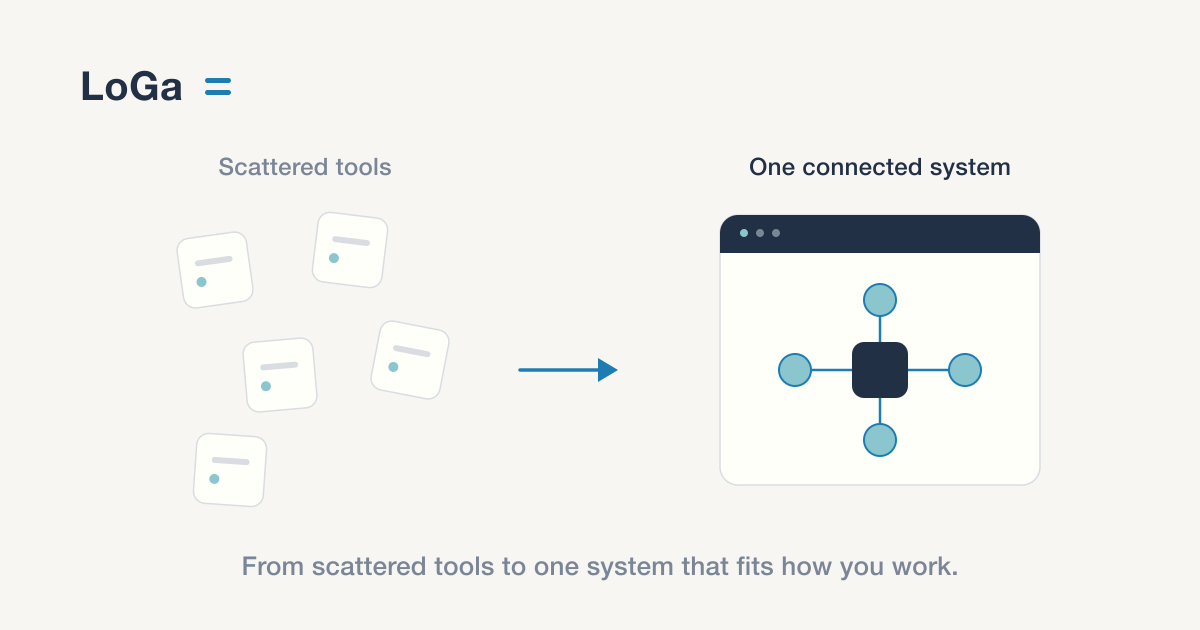
Off-the-shelf software is built for the average of thousands of businesses — not for how yours actually runs. So its real limitation isn't a missing feature. It's a mismatch. The tool forces your business to adapt to its workflow, instead of adapting to yours. Information ends up split across apps that don't talk to each other, your team fills the gaps by hand, and the knowledge that should live in the system lives in people's heads instead. The tools keep multiplying, too: BetterCloud found that the average company ran 112 SaaS apps in 2023 — and more logins rarely means more connected.
It rarely breaks loudly. That's what makes it dangerous.
The hidden cost: it doesn't break loudly
Most of the time, generic software just creates small friction, every single day. A delayed update. A missed detail. A customer left waiting. A job that needed attention yesterday. A team member asking a question the system should have already answered.
None of those is a crisis on its own. Added up across a year, they're the difference between a business that feels calm and one that feels like it's always one step behind. The cost is real — it's just spread thin enough that you stop seeing it. It is also measurable: Harvard Business Review reported that employees toggle between applications about 1,200 times a day, losing close to four hours a week — roughly 9% of their time — just switching between tools.
Signs you've outgrown off-the-shelf software
You don't need a consultant to know. You've outgrown it when:
- Your team has invented manual workarounds to make the software fit how you actually work.
- The same information is entered in two or three different places.
- Key details ("what's the status of that job?") live in someone's memory, not in a screen anyone can check.
- You're paying for features you never use while still missing the one or two things you actually need.
- The honest answer to "where does that live?" is a shrug.
If a few of those sound familiar, the problem isn't your team. It's that the system was never built around them.
What a system built around your business looks like
This is one of the biggest things we saw while building for MASB Construction & Remodeling LLC, a remodeling company in Oklahoma City. On paper, they had tools. In practice, the team was working around them.
So we didn't hand them another app. We built a command center around how they actually run jobs — quotes, scheduling, customer details, job status, follow-ups, pending items, and the numbers the owner actually checks — in one place.
Inside that system, we added Leslie, their smart business assistant. Not a chatbot bolted on to look modern. Leslie is connected to the live dashboard, so the owner can ask what's happening — which jobs are active, who needs a follow-up, what's pending, what changed this week, what needs attention first — and get answers from the real information inside the business.
The important part: Leslie gets sharper over time. The more the business runs through the system, the more context it has — what the team checks, what usually gets delayed, what patterns keep showing up before they become problems.
That's the whole difference. Generic software makes the business adapt to it. A real system adapts to the business.
Talent gets you in the game. Systems keep you there.
The best teams I played on weren't carried by one star. They were carried by a system everyone could trust — so talent had something solid to stand on. Businesses work the same way. Your people are good. The question is whether the system underneath them is helping them, or quietly making them work harder than they should.
At LoGa, that's what we build: one dashboard, one smart assistant, one system that gets better the more your business uses it. Not AI for the sake of looking modern — intelligence built into how you already run.
If your software "works" but your team is working around it, it might be time to see what a system built around your business could look like. Whether that build returns more than it costs is a numbers question before it is a software question, and is custom software worth it is how we work through it. If you want that mapped against your own week rather than in the abstract, that is what a systems audit is for.
Frequently asked questions
What are the limitations of off-the-shelf software? Off-the-shelf software is built for the average of thousands of businesses, not for how yours actually runs. Its real limitation is fit: it forces your team to adapt to its workflow, splits your information across apps that don't talk to each other, and often leaves you paying for features you never use while missing the one or two you actually need.
What is one of the biggest disadvantages of off-the-shelf software? It rarely breaks loudly. Instead it creates small friction every day — a delayed update, a missed detail, information living in someone's head — and those add up to a business that always feels one step behind.
What is the difference between off-the-shelf and custom software? Off-the-shelf software is pre-built for a broad audience, so you adapt your business to it. Custom software is built around how your business actually runs, so the system adapts to you.
When should a business switch from off-the-shelf to custom software? When your team has invented manual workarounds to make the software fit, the same information is entered in two or three places, and the answer to "what's the status of that?" lives in someone's memory instead of a screen anyone can check.
Does building a custom system mean adding AI? Not necessarily. The goal isn't to "use AI" — it's a system built around your operation. AI, like a connected assistant, earns its place only when it makes the business run cleaner, not when it's added to look modern.