AI Search Visibility: How We Build a Local Business's Presence
AI search visibility is whether Google, ChatGPT, and similar tools can find your business, understand what it does, and trust the facts enough to mention it when a customer asks. No one can make those systems recommend you. What a builder can do is remove the reasons they would skip you: missing or conflicting facts, pages a crawler cannot read, and questions your website never answers. At LoGa, that is the job, and it is mostly careful, repeatable work rather than a trick.
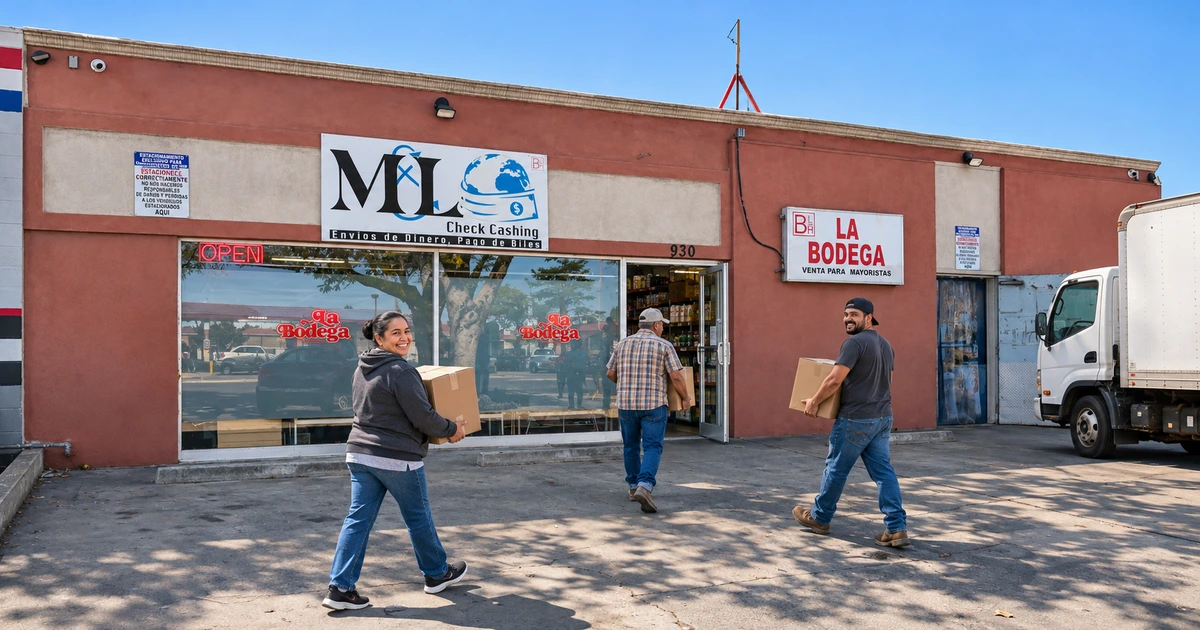
This article walks through how we actually do it, from the first list of business facts to the checks we keep running afterward. We use La Bodega Wholesale, the Santa Maria, California distributor in the photo above, as the example, using only what it publishes on its own website. The image is an illustrative composite: the storefront is real, and the people and the truck were added with AI. If you want the definitions first, our guide to SEO vs AEO vs GEO covers the vocabulary. This one is about the method.
What AI Search Visibility Means for a Local Business
When someone asks Google "where can I buy Mexican snacks wholesale near Santa Maria" or asks ChatGPT the same thing in Spanish, the system has to do three things before your name can appear. It has to find pages about you. It has to read them and work out what kind of business you are, where you are, and what you sell. And it has to be confident enough in those facts to repeat them.
Each step can fail for an ordinary reason. The address on the website does not match the one on Google. The hours on the Business Profile are a year old. The product list loads only after a script runs, so a crawler sees an empty page. The site says "quality products at great prices" but never says which products, for whom, or where.
Google's own guidance keeps this grounded. On AI Overviews and AI Mode, Google says: "There are no additional requirements to appear in AI Overviews or AI Mode, nor other special optimizations necessary." A page has to be indexed and eligible to show in Google Search with a snippet, the same as any search result (Google Search Central, AI features and your website). That is why our method looks a lot like careful local search work. It is the same foundation, checked more strictly.
Step 1: We Start With One Sheet of Business Facts
Before we touch a website or a profile, we write down the facts every other system will be checked against. One sheet, owned by the business, with a date on it:
- The legal and public name, spelled exactly one way.
- Address, phone, email, and hours, including holiday or seasonal hours.
- What the business sells or does, in plain nouns a customer would type.
- Who it serves, such as restaurants, food trucks, homeowners, or contractors, and whether it sells to the public.
- Where it serves, as towns or ZIP codes, not "the surrounding area."
- The rules customers ask about most, such as minimums, delivery, payment, returns, and lead times.
This sounds basic, and that is the point. Most visibility problems we see start here: two phone numbers in circulation, an old suite number, a delivery area nobody wrote down. If the business cannot state a fact consistently, no search engine or AI tool can either.
For La Bodega, the public version of that sheet is short and specific. Its website describes it as a family business since 2015 that distributes Mexican products wholesale from 930 W Main St in Santa Maria, with categories for snacks, drinks, bread and sweets, condiments and coffee, and disposables. It states a $250 minimum, before tax, for local delivery and no minimum for pickup at the warehouse. Those are the kinds of facts an answer has to get right, and the kinds a customer will notice when they are wrong.
Step 2: We Make the Google Business Profile Match That Sheet
For a local business, the Google Business Profile is usually the record Google trusts most about the basics. We bring it in line with the fact sheet: name, category, address, phone, hours, website, service area, and a description that uses the same plain nouns as the website.
Google is direct about what it rewards here. Its help page says "Businesses with complete and accurate info are more likely to show up in local search results," and that local results are mainly based on relevance, distance, and popularity. It is also direct about what no one can buy: "There's no way to request or pay for a better local ranking on Google" (Google Business Profile Help).
Distance is not something we can change, so we do not pretend to. Relevance comes from accurate categories, services, and descriptions. Popularity comes partly from reviews, which are an operations habit more than a marketing campaign. Our guide on how to ask for Google reviews covers how to ask every customer the same way without breaking Google's rules.
Step 3: We Build Pages That Answer Real Customer Questions
Next comes the website. We build pages around the questions customers actually ask, written so a person gets the answer in the first sentence or two, and so a machine can lift that answer without guessing.
In practice, that usually means:
- A clear page for each main service or product category, named the way customers name it.
- A frequently asked questions page for minimums, delivery, hours, payment, and returns, with the answers in plain text.
- Location and service-area wording that names real towns, not just "your area."
- Guides for questions that need more than a sentence, written in the languages the customers use.
La Bodega's site shows this pattern in public. The storefront is in Spanish, its categories match how buyers think about stocking a store or a kitchen, its FAQ page covers the minimum order, delivery, hours, payments, taxes, and returns, and it publishes buying guides in Spanish and English. LoGa built that website, and the site credits us in its footer. We are not sharing its traffic or sales here; the example is the structure, not a result.
If an answer depends on details that change, such as prices or stock, we keep it on a page the business can update itself, so the website and the business never disagree for long. The same rule applies to a website assistant, which we cover in our guide to testing an AI chatbot before customers do.
Step 4: We Make Sure Google and AI Crawlers Can Read the Site
A page nobody can read does not exist to a search engine. This step is technical, and it is where many good-looking sites quietly fail.
The content has to be in the page itself. We serve real HTML for every important page, so the text, headings, and links are there when a crawler first loads them, not only after scripts run. A slow or script-heavy site also tends to frustrate people on phones; our guide to why a website is slow covers what usually causes that.
The robots.txt file has to allow the right crawlers. OpenAI documents its crawlers separately. It says "OAI-SearchBot is used to surface websites in search results in ChatGPT's search features," and that sites opted out of it "will not be shown in ChatGPT search answers." GPTBot is a different crawler, used for content that may train OpenAI's models (OpenAI, Overview of OpenAI Crawlers). Those are two separate decisions, and we make each one with the owner. La Bodega's public robots.txt explicitly allows search and AI crawlers on its public pages while keeping private areas like the cart and account pages blocked.
Structured data has to describe the business accurately. We add Schema.org markup for the organization and the local business, including name, address, phone, area served, and opening hours, matching the fact sheet exactly. We are careful about what this does. Google says it "does not guarantee that your structured data will show up in search results, even if your page is marked up correctly" (Google Search Central, structured data policies). Markup makes the facts unambiguous. It is not a switch that turns on visibility.
We sometimes also publish a plain-text summary file for AI tools, such as an llms.txt. It is cheap to maintain, but neither Google's nor OpenAI's documentation we rely on says it affects whether a business is shown, so we treat it as a convenience, not a lever.
Step 5: We Check How Google and AI Tools See the Business
Building is half the work. The other half is checking, on a schedule, whether the systems read what we built the way we intended.
In Google Search Console, we use the URL Inspection tool to see whether important pages are indexed and what Google's crawler actually received. When a page is new or has changed, we can request indexing, which Google describes as a request "that a URL be crawled" (Search Console Help, URL Inspection tool). A request is not a promise. We report "indexing requested" and "indexed" as two different things, because they are.
In the AI tools themselves, we ask the questions a customer would ask, in the language they would use. For a business like La Bodega, that means questions in Spanish and English about where to buy specific products wholesale, delivery to particular towns, and order minimums. We write down what comes back: whether the business is named, whether the facts are correct, and which sources the answer cites.
We are careful with what those checks prove. AI answers vary with wording, location, account, and time, and the same question can return a different answer an hour later. So we repeat a fixed set of questions on a schedule and look for patterns, such as a wrong fact that keeps appearing or a source that keeps getting cited. When an answer is wrong, we trace it to where the wrong fact lives, whether that is an old directory listing, an outdated page, or a profile field, and fix it there.
What We Measure, and What We Won't Call Proof
We report numbers the business can check for itself:
- Search Console performance: impressions, clicks, and the queries that triggered them. Google says sites appearing in AI Overviews and AI Mode are included in the overall search traffic in Search Console, in the Performance report under the "Web" search type.
- Indexing status for the pages that matter, and any errors Google reports.
- Business Profile activity, such as calls and website clicks, as the profile reports them.
- Real leads: the calls, forms, orders, and walk-ins the business receives, and where each one came from, which means asking and recording it.
- The AI answer log: the fixed questions, the dates, and what each tool said.
We will not report a made-up "AI visibility score," a single screenshot of ChatGPT naming the business as if it were a permanent ranking, or traffic numbers without the context of what the business sells. If a number cannot be reproduced by someone else looking at the same tool, we do not use it as evidence.
What Stays Outside Our Control
Being honest about the limits is part of the method:
- Rankings and recommendations. Google decides local results and AI answers. OpenAI decides what ChatGPT says. We influence the inputs, not the outcome.
- Distance. A customer across town may see a closer competitor first, and no amount of work changes the map.
- Reviews. We can help the business ask every customer consistently and reply well. We cannot write reviews, and we will not filter them.
- Third-party sites. Old directory listings, news articles, and social pages can carry outdated facts. We can find them and request corrections, but we do not control how fast another site updates.
- Timing. Google does not promise to crawl or index any page on a schedule, and AI tools refresh what they know at their own pace.
- How the business runs. If hours, prices, or policies change and nobody updates the fact sheet, the website and profile drift out of date, and the answers follow.
How LoGa Works on Search and AI Visibility
LoGa AI Systems is an Oklahoma City company that builds websites, custom software, and AI systems for service businesses. We treat search and AI visibility as part of the same system as intake and follow-up, because a customer who finds you through an AI answer still has to call, order, or book, and that step has to work too. For the bigger picture of how AI search changes local marketing, see our guides to AI search and local SEO and answer engine optimization for local businesses.
We do not promise placement in Google or ChatGPT. Our part is a clean fact sheet, a matching profile, pages that answer real questions, a site machines can read, and a regular check on what the systems say back.
The LoGa platform shows how the website, intake, and follow-up fit together, and what we handle lists the work we take on. If you would like us to look at how your business shows up in search and AI answers today, book a free bottleneck audit.
Frequently asked questions
Can you guarantee my business will appear in ChatGPT or Google's AI answers? No, and no one honestly can. Google says there is no way to request or pay for a better local ranking, and it does not guarantee that a page will be crawled, indexed, or shown. ChatGPT decides its own answers too. What we can do is remove the reasons a system would skip you: missing or conflicting facts, pages crawlers cannot read, and questions your site never answers.
Does my business need special optimization for Google's AI Overviews? Google says there are no additional requirements and no special optimizations needed for AI Overviews or AI Mode. A page has to be indexed and eligible to appear in Google Search with a snippet, which is ordinary search eligibility. So the work is the same groundwork: accurate facts, a complete Business Profile, and clear, crawlable pages.
Should I block AI crawlers from my website? It depends on which crawler and what you want. OpenAI runs separate crawlers: OAI-SearchBot surfaces sites in ChatGPT search, while GPTBot collects content that may be used to train its models. OpenAI says sites that block OAI-SearchBot will not be shown in ChatGPT search answers. Many local businesses allow the search crawler and make a separate choice about training.
How do you check whether AI tools understand a business? We ask the questions a real customer would ask, in the language they would use, and write down what comes back: whether the business is named, whether the facts are right, and which sources are cited. We repeat the same questions on a schedule. One answer is a snapshot, because AI answers change with wording, location, and time, so we track patterns instead of treating a single answer as a ranking.
What do you measure to tell whether the work is helping? We use numbers the business can verify: impressions, clicks, and search queries in Google Search Console, which includes traffic from Google's AI features; the actions reported on the Business Profile; and the calls, forms, and orders the business actually receives, with where each one came from. We do not report an invented AI score or a ranking we cannot reproduce.