Is Custom Software Worth It for a Small Business? An Honest Look
You bought the software. It works. So why does running the business still feel like it's held together with tape?
If you're asking whether custom software is worth it for a small business, you've probably already hit the wall: the tool does most of what you need, and your team quietly handles the rest by hand — a spreadsheet here, an "I'll text you the details" there, the same customer typed into three different systems. The software works. Your people are working around it.
So is building your own actually worth it? The honest answer is: sometimes yes, sometimes no. Below is how to tell the difference — including the cases where you absolutely shouldn't.
What "custom software" actually means (and what it doesn't)
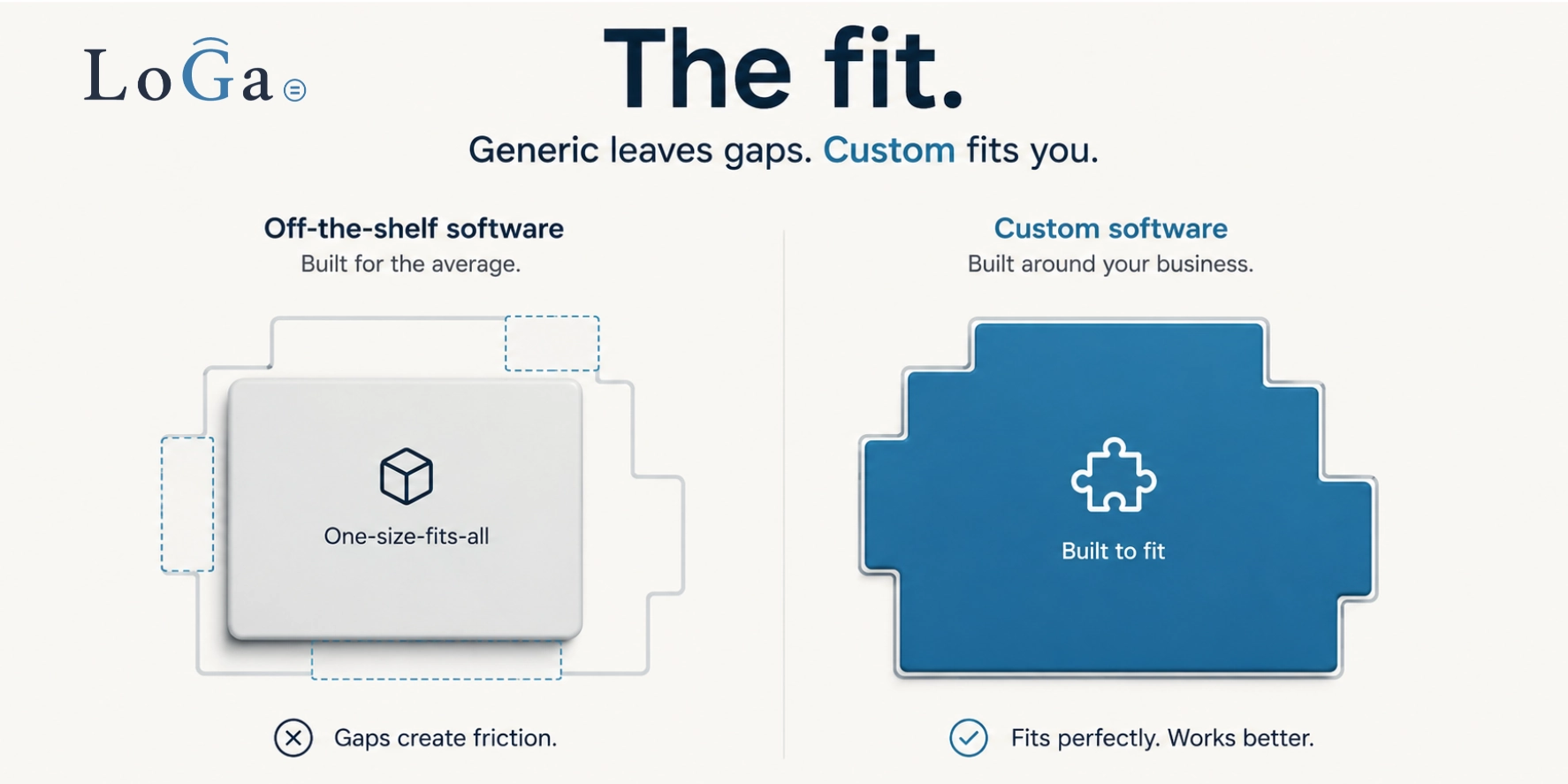
Off-the-shelf software is built for the average of thousands of businesses. It nails the parts every business shares — invoicing, basic scheduling, email — and leaves the parts that make yours yours up to you. That's not a defect; it's the business model. A tool built for everyone can't be built for you.
Custom software flips that. Instead of you bending your business around the tool's workflow, the system is built around how your business actually runs — your steps, your bottlenecks, your team, the exceptions only you have to handle. (We went deeper on why generic tools quietly stop fitting in our piece on why off-the-shelf software stops working — worth a read if that "it works, but…" feeling sounds familiar.)
One myth worth killing early: "custom" doesn't mean building everything from scratch. The smartest version is usually a hybrid — keep the off-the-shelf pieces that genuinely work, and build the connective system around them so the whole thing runs as one instead of as a pile of disconnected apps.
Signs you've actually outgrown off-the-shelf software
You don't need an audit to know. You've outgrown it when:
- Your team has invented manual workarounds to make the software fit how you actually work.
- The same information gets entered in two or three different places.
- Key answers ("what's the status of that job?") live in someone's memory instead of a screen anyone can check.
- You're paying for features you never touch while still missing the one or two you actually need.
- The honest answer to "where does that live?" is a shrug.
If several of those are true, the question stops being "should we build something custom?" and becomes "what are these workarounds already costing us?"
What does custom software cost for a small business?
Here's where most articles get vague or invent a number. We won't.
The real cost isn't only the build — it's the comparison. Custom software is a genuine investment: it's a build, not a $40-a-month subscription, and the price depends entirely on how much you're solving. But the number that actually matters is the one no invoice shows you: the cost of the workarounds. The hours your team spends re-entering data. The follow-up that slipped because it lived in someone's head. The customer who waited. The missed call that became a missed job.
Add those up over a year and you have the real budget you're already spending — just quietly, in friction instead of in dollars. Custom software is "worth it" when the system removes enough of that friction to pay for itself, and then keeps paying. If it doesn't clear that bar, don't build it.
When custom software is NOT worth it
This is the part the agencies skip, so we'll say it plainly: a lot of the time, you shouldn't build custom software.
Stick with good off-the-shelf software when:
- Your needs are standard and a mature tool already does the job well. If a proven $50-a-month app runs your scheduling cleanly, use it.
- You're early. Before you've found a repeatable way of working, building a system around it just locks in guesses.
- Your budget is tight and the pain is mild. Custom is for friction that's genuinely costing you — not for looking sophisticated.
- The workflow isn't really yours. If thousands of businesses do it the exact same way, someone has already built it better than a one-off ever could.
Building custom software to feel like a "real company" is the most expensive mistake on this list. The honest test is simple: if the off-the-shelf tool fits how you work, keep it. Custom earns its place only where the misfit is real and recurring.
So — is it worth it? The real test
For a small business, custom software is worth it when three things are true at once:
- The gap between how the software works and how you work is costing you something every day.
- That workflow is core to how you make money or serve your customers — not a side task.
- A system built around you would actually remove the friction (and, ideally, get smarter the more you use it).
When all three hold, the workarounds are the expensive option — you're just paying for them in a currency that never shows up on a bill. When they don't, off-the-shelf is the smart, frugal choice, and anyone telling you otherwise is selling.
What it looks like in practice
Theory is easy. Here's a real one.
We built a system for MASB Construction & Remodeling LLC, a remodeling company in Oklahoma City. On paper, they had tools. In practice, the team was working around them — scheduling in one place, customer details in another, job status remembered by whoever took the call, follow-ups living in someone's head.
We didn't hand them another app. We built a command center around how they actually run jobs — quotes, scheduling, customer details, job status, follow-ups, pending items, and the numbers the owner actually checks — in one place. Inside it, we added Leslie, a smart assistant connected to that live data, so the owner can ask what's happening — which jobs are active, who needs a follow-up, what changed this week — and get answers from the real information inside the business.
Was it worth it? The test above is the answer: the misfit was real, the work was core, and the system removed friction they'd been absorbing by hand for years. That's the bar — not whether custom software is impressive, but whether it quietly pays for itself.
Where AI fits (and where it doesn't)
It's 2026, so this matters: a custom system can include intelligence that compounds. Leslie gets sharper over time — the more the business runs through the system, the more it understands what gets checked, what slips, and what needs attention before it becomes a problem.
But AI is only worth it when it makes the business run cleaner — not when it's bolted on to look modern. The goal was never to "use AI." The goal was a system that fits, with intelligence built into how the business already runs.
The honest bottom line
Custom software is worth it for a small business when your tools work but your team is working around them, the friction is costing you real time and money, and the workflow is genuinely yours. It is not worth it when off-the-shelf already fits — and a good partner will tell you that before they ever quote you a build.
If that "it works, but we're always one step behind" feeling sounds like your business, it's worth seeing what a system built around how you actually run could look like.
Frequently asked questions
What is the difference between custom and off-the-shelf software? Off-the-shelf software is pre-built for a broad audience, so you adapt your business to it. Custom software is built around how your business actually runs, so the system adapts to you. Off-the-shelf is faster and cheaper to start; custom fits better and removes the manual workarounds generic tools leave behind.
What are the disadvantages of custom software? It costs more upfront and takes longer to build than buying a ready-made tool, and it needs ongoing maintenance. It's also the wrong choice when your needs are standard — if a proven off-the-shelf app already fits how you work, custom software is an expensive way to solve a problem you don't have.
How much does custom software cost for a small business? It varies widely with what you're solving, because it's a build rather than a subscription. The more useful number is the cost of your current workarounds — the hours re-entering data, the slipped follow-ups, the missed calls. Custom software is worth it when it removes enough of that friction to pay for itself over time.
Why are more small businesses moving to custom software? Because they've outgrown one-size-fits-all tools. As a business matures, its real workflows get specific, and generic software forces the team into manual workarounds. A system built around the business removes that friction and can connect the tools they already use into one place.
Is custom software worth it for a small business? Yes — when the gap between how your software works and how you work is costing you daily, the workflow is core to your business, and a tailored system would remove that friction. It's not worth it when off-the-shelf software already fits your needs.