AI Receptionist for Contractors: What an AI Voice Agent Actually Does
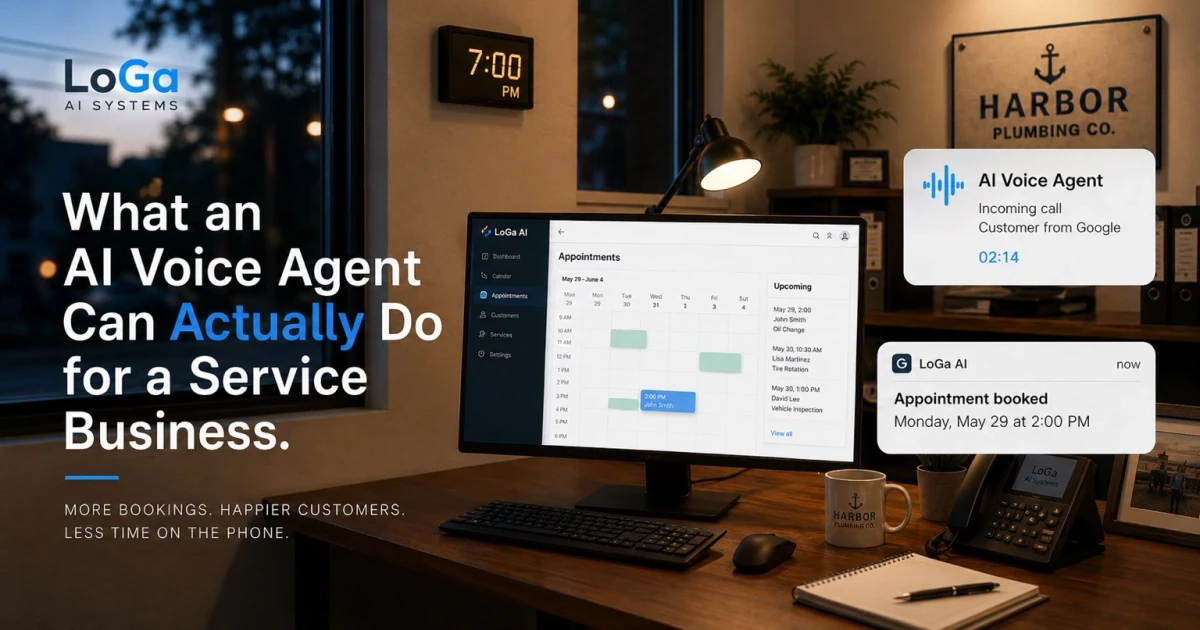
If you have been searching for an AI receptionist for contractors, this is that product under a plainer name.
An AI voice agent for service businesses is software that answers the phone in a natural voice, understands why the caller is reaching out, and takes a defined next step—capturing their details, answering a common question, booking an appointment when it fits your rules, or handing the call to a person. It is not a robot pretending to be human, and it is not a replacement for your team. It is coverage for the calls that would otherwise go to voicemail.
That distinction matters, because the real problem in most service businesses isn't the phone—it's the gaps around it. Calls arrive when the team is on a job, at lunch, or already on another line. They arrive after you close. And when intake depends on whoever happens to pick up, the notes, the routing, and the follow-up come out different every time. A missed or fumbled call rarely announces itself; it just quietly becomes a booking at the next business down the list.
What is an AI voice agent?
An AI voice agent is a phone-based version of a system that already knows how your business handles calls. It listens, understands plain speech, and responds in a natural voice—then acts on what it heard.
Older phone menus ("press 1 for scheduling") route people through a fixed tree. An AI voice agent skips the tree: the caller just says what they need, and the agent decides the next step from your rules. The useful part is not that it talks. It's that it can do something with the call—capture it, book it, or route it—instead of only recording a message.
What can an AI voice agent do well?
An AI voice agent is strongest at the repeatable parts of intake—the work that is consistent, rule-based, and happening at volume. In practice, that means it can:
- Capture caller information. Get the name, number, reason for calling, and any details you always ask for—recorded the same way every time.
- Answer common questions. Hours, location, services offered, pricing ranges, "do you take my insurance"—the questions that don't need a person but still deserve an answer.
- Route urgent requests. Recognize an emergency or a high-priority caller and move them down a different, faster path instead of a shared voicemail.
- Create appointment requests. Collect what's needed to schedule, and—when connected to a live calendar—book a time that fits your rules.
- Summarize calls. Turn each conversation into a clean record: who called, what they wanted, and what happened next.
- Trigger follow-up. Kick off a text, an email, or a task so nothing depends on someone remembering.
- Hand off to a human. Pass the call, with context attached, the moment it's beyond scope.
The common thread is that these are decisions you can define in advance. Speed is the clearest example of why that pays off: Lead Response Management found a roughly 21-fold drop in the odds of qualifying a lead when response time slips from five minutes to thirty. A voice agent answers on the first ring, every time—which is exactly where a busy team can't.
What should an AI voice agent not handle alone?
A voice agent earns trust by knowing its limits. It should not be positioned to:
- Replace every human conversation. Judgment, empathy, and negotiation are not intake tasks. Some calls are the relationship, and those belong to a person.
- Handle every edge case perfectly. Unusual requests, confused callers, and situations no one scripted will happen. The right behavior is to recognize the limit and escalate—not to improvise.
- Make guarantees. It should never promise an outcome it can't verify—no confirmed booking before the calendar actually accepts it, and no commitment your business hasn't approved.
- Remove the need for escalation paths. A voice agent doesn't eliminate the human handoff; it makes the handoff cleaner. If a design assumes no one will ever need to step in, that's the design failing, not the caller.
A voice agent that overreaches is worse than no voice agent, because it fails silently—confidently giving a wrong answer instead of routing to someone who knows.
Where does an AI voice agent fit in a service-business workflow?
The right place for a voice agent is the gap between "the phone rang" and "a person could answer it." It sits in front of your existing process, not on top of your team.
Picture a plumbing company mid-afternoon, every tech on a job. A homeowner calls about a leak. Instead of voicemail, the agent answers, captures the address and the problem, checks whether it's urgent, and either books the next available window or flags it for a callback with the details already logged. The office doesn't return to a blinking light and a guess—it returns to a qualified request.
This is the same pattern behind how to stop missing customer calls: give every unanswered call a defined next step instead of a dead end. The voice agent is one way to deliver that step on the phone specifically—during peak hours, after close, and on overflow lines. What it should do before the phone rings, while the caller is on the line, and after they hang up is its own subject, laid out in how an AI call answering system works.
What should an AI voice agent for service businesses connect to?
A voice agent that can talk but can't act is just a nicer voicemail. The value comes from what it's wired into. A useful setup connects to:
- Calls — the phone line itself, so the agent can answer and speak naturally.
- CRM — so a caller is recognized and the conversation lands on the right record instead of a sticky note.
- Calendar — so it books against real availability and your own scheduling rules, not a guess.
- Forms — so a phone intake and a web form feed the same place, in the same shape.
- Follow-up — so a text or task fires automatically when a call needs one.
- Human handoff — so the moments that need a person get routed to one, with the context already attached.
When those pieces are disconnected, you get the same failure a lot of businesses know well: tools that each work fine alone but drop the ball between them. That's the difference between a bolt-on voice bot and a designed system—the same reasoning we lay out in custom AI software vs off-the-shelf tools.
What are the risks and guardrails?
Putting an automated voice in front of customers is a real responsibility, so the guardrails matter as much as the features. A serious build should include:
- Escalation. A clear, fast path to a human for anything urgent, sensitive, or out of scope—triggered by the agent, not left to the caller to demand.
- Fallback. A defined behavior when the agent is unsure: capture the details and route, never bluff. "I'm not certain, so I'll get this to the right person" beats a confident wrong answer.
- Handling wrong answers. The agent should only speak from approved, current information, and stay in its lane. Guessing at pricing, policy, or availability is how trust breaks.
- Urgent requests. Emergencies need their own path that skips straight to a person or an on-call process—not a booking flow.
- Consent and recording. If calls are recorded, callers should be told, and the practice should follow the rules for your state and industry. Recording law varies by jurisdiction, so this is worth confirming rather than assuming.
None of these are optional polish. They're the difference between a voice agent that protects the customer relationship and one that quietly erodes it.
Is an AI Receptionist for Contractors Any Different?
The technology is the same. What changes is what the caller is calling about, and that changes the rules you have to write.
A contractor's phone does not ring with appointments. It rings with problems — a leak, no heat, a panel tripping — and the first job is triage, not booking. The agent has to tell an emergency from a quote request before it decides anything else, because those two calls should end in completely different places.
The service area is a real qualifier. A restaurant takes every call. A contractor forty minutes outside their radius is a call worth ending politely and quickly. An agent that books it anyway has cost you a truck.
Nobody is at a desk. In an office business the handoff is a transfer. For a contractor there is no one to transfer to at two in the afternoon, so "escalate to a person" has to mean something concrete — a text to the owner, a task with the address and the problem attached, a callback slot that somebody will actually see.
Half the calls are about a job already in progress. "Is he still coming?" is not a new lead, and an agent that treats it as one will annoy an existing customer. It needs to reach the schedule to answer that at all.
That is the whole difference: not a different product, a different set of rules. Anyone selling you an AI receptionist for contractors that does not ask about your service area, your emergency criteria, or your schedule is selling you the office version with a new label.
LoGa designs the system, not just the voice
An AI voice agent is a genuinely useful tool for a service business—for capturing callers, answering the routine questions, booking when the rules allow, and handing off cleanly when a person is needed. What it isn't is a magic box you drop on the phone line and forget. The results come from the design around it: the rules, the connections, and the escalation paths that decide what happens after the agent picks up.
At LoGa AI Systems in Oklahoma City, that's the work—building the full system a voice agent lives inside, so calls, CRM, calendar, follow-up, and human handoff behave as one process instead of a pile of disconnected tools. If the phone is where leads slip through, our missed-call recovery systems are built around those exact gaps. The voice on the call is the easy part; the system behind it is what makes it worth answering.
Frequently asked questions
What is an AI voice agent? An AI voice agent is software that answers a phone call in a natural voice, understands what the caller is asking, and takes a defined next step—collecting details, answering a common question, booking an appointment when it fits the rules, or routing the call to a person. It is the phone version of a system that already knows how your business handles calls.
Can an AI voice agent replace a receptionist? No, and it should not try to. A good AI voice agent covers the calls a person cannot get to—busy hours, after hours, and overflow—and handles the routine, repeatable parts of intake. The judgment, empathy, and messy edge cases still belong to your team. It is coverage, not a replacement.
What kinds of calls should still go to a person? Anything that needs judgment, negotiation, or care: emergencies, upset or sensitive callers, complex quotes, complaints, and anything outside the agent's defined scope. A well-designed voice agent recognizes these and hands them off quickly, with the caller's details already captured, instead of guessing.
Can an AI voice agent book appointments? Yes, when it is connected to your real calendar and booking rules. It can check genuine availability, offer times that fit your rules, and place the appointment—then confirm only after the booking actually succeeds. If it is not connected to live availability, it should take a request and route it, not promise a time it cannot guarantee.
Does an AI voice agent work after hours? Yes. After-hours and weekend calls are one of the clearest places a voice agent helps, because the alternative is usually voicemail. It can answer, capture the caller, book when the request fits, and flag anything urgent for the next business morning—so an evening call becomes a real record instead of a missed one.
How much does an AI receptionist cost? It is priced by what it carries, not by the voice, so any number quoted before someone has asked how you take calls is a guess. The things that actually move it are how many calls a month it handles, how many hours it covers, how many questions it has to answer correctly, whether it books into a real calendar, whether it writes back to the systems you already run, and how carefully the handoff to a person is designed. A voice that only answers is cheap and mostly useless. Ask any vendor to price the connected version and to show you what happens on the calls it cannot finish.
The phone will keep ringing when your team is busy or closed. The question is whether the next step is already decided before it does.