Missed Call Text Back: How to Stop Missing Customer Calls
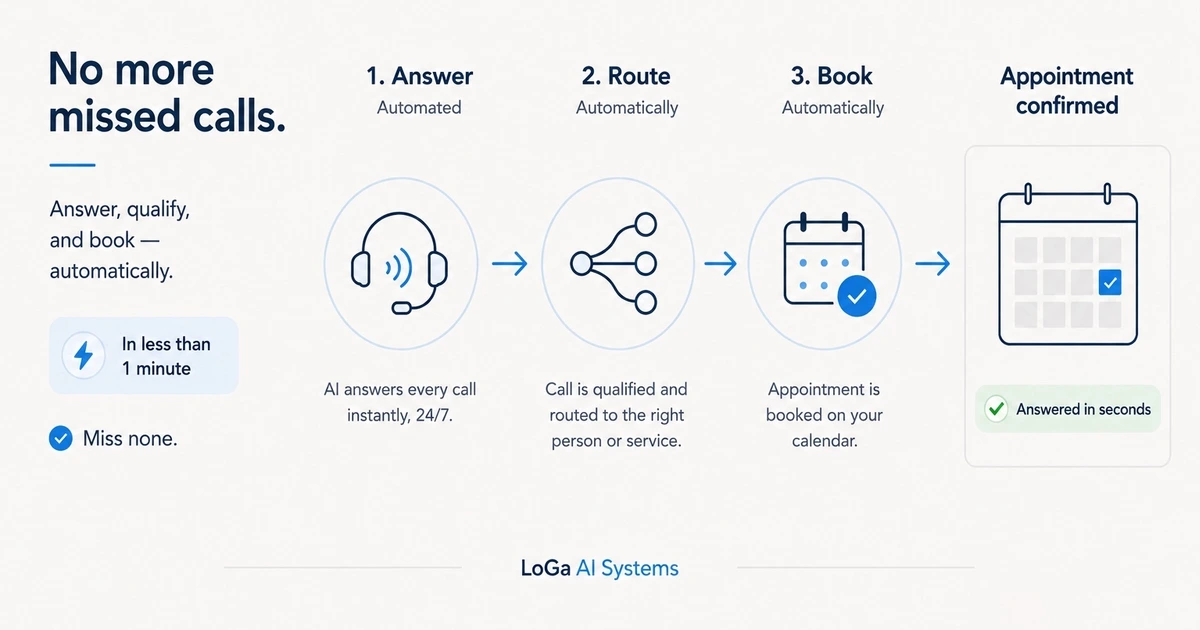
The cheapest version of this is missed call text back: the phone rings out, and the caller gets an automatic text within seconds. It works, up to a point.
If you want to know how to stop missing customer calls, the fix is rarely about staffing—it's about systems: deciding what should happen before the next call comes in, instead of asking an already-busy team to answer faster.
In baseball, the play is called before the pitch. When a ground ball heads toward short, the shortstop already knows where to throw. The first baseman is already moving. Nobody hesitates because the decision was made before the ball was hit.
Most service businesses don't have that kind of system for the phone. The call comes during an appointment, a job, or a packed front-desk hour. It rings until it stops. Then the caller tries the next name on Google.
Why do service businesses keep missing calls?
You're not missing calls because you don't care. You're missing them because customers tend to call at the exact moment your team is least available.
A patient calls when a tooth starts hurting. A homeowner calls when a pipe breaks. The urgency belongs to the caller, while your schedule belongs to the work already in front of you. Those two things rarely align on their own.
Hiring another receptionist can add coverage, but it doesn't remove the underlying gap. Lunch breaks happen. Mornings get packed. People get sick. After-hours calls still arrive.
That makes missed calls less of a staffing failure and more of a design flaw. The business has no reliable next step when a person can't answer.
What does a missed call cost a small business?
The cost isn't the ringing itself. It's the job, appointment, or customer relationship behind it.
OnceHub estimates that a home-services lead may be worth $300 to $1,200, while a dental or medical lead may represent $800 to $2,000 in lifetime value. Davinci Virtual Office reports, citing Eden, that missing two calls per weekday can cost a business more than $9,000 a year.
Those figures won't fit every company. Your real number depends on call quality, conversion rate, average job value, and repeat business.
The pattern is still useful: missed calls compound. A caller who can't reach you may book with another company, and one lost appointment can become years of business that never reaches your calendar. Speed is part of it, too: Lead Response Management research found the odds of qualifying a lead drop roughly 21-fold when the response time slips from five minutes to thirty.
Where do customer calls usually get lost?
Most missed calls happen in three predictable places:
- During peak hours. The phone is busiest when the team is already handling customers—the calls with the most intent arrive when there's the least room to answer them.
- After hours. Someone decides to book at 8 p.m. Your voicemail answers, but the next business on Google may answer the actual question.
- During handoffs. A call routes to someone unavailable, lands in voicemail, and waits until the next day. By then, the caller has moved on.
These aren't random events. They're recurring conditions. Predictable problems deserve a defined response.
How to stop missing customer calls without adding staff
To stop missing customer calls without hiring, give every unanswered call a defined next step instead of a voicemail. Three moves do most of the work:
- Create an always-available intake layer. When no one can answer, the system collects the caller's name, identifies why they're calling, and—when the request fits your rules—offers an appointment.
- Use triage rules instead of one voicemail box. An urgent request should follow a different path than a routine booking, so important calls keep moving instead of piling up as manual follow-up.
- Turn every call into a record. Log who called, when they called, what they needed, and what happened next—so the team starts the morning with a clear queue rather than a list of unknown numbers.
This doesn't require forcing the business into a generic answering product. A system built around the operation can follow the actual appointment types, escalation rules, and software the team already uses.
It's the same principle behind how Edgar Lopez, founder of LoGa AI Systems, approached his recovery from major surgery: decide the system before the difficult moment arrives. He planned the work around each hour instead of relying on motivation or guesswork. Incoming calls deserve the same treatment—the goal isn't more people in front of the phone, it's a useful next step waiting for every call.
What Missed Call Text Back Actually Does — and Where It Stops
Missed call text back is one rule: the call goes unanswered, an automatic text goes out. It is the cheapest thing on this list and it is genuinely worth doing.
What it does well is buy you the moment. A caller who gets a text in ten seconds usually stops dialling the next name on the map. That alone recovers work that would otherwise be gone before you noticed it rang.
Where it stops is the moment they reply. The text arrives, the customer answers it, and now there is a conversation sitting in a phone that may or may not be watched. If it lands in a shared inbox nobody owns, or on the office phone at four on a Friday, the lead is still lost — it just took an extra step to lose it.
The second limit is that it captures nothing. You get a phone number and whatever they chose to type. The job type, the address, the urgency, whether they are inside your service area — none of it is asked, so somebody still has to run the whole intake by hand afterwards.
So the honest positioning: missed call text back is a good first move and a poor last one. Do it this week if you do not have it. Then decide whether the replies are reaching a system or a pile.
What does automated call handling look like in practice?
In practice, automated call handling answers the call, identifies what the caller needs, checks real availability, books the appointment when it fits the rules, and routes anything that needs judgment to a person—no one has to pick up for the first useful step to happen.
Consider a dental practice that receives an after-hours call from a prospective patient. The intake system answers, collects the caller's details, identifies the type of appointment they need, and checks the practice's approved availability. If the request fits the booking rules, it confirms a time and notifies the team. If it needs a person, it creates an urgent follow-up with the context already attached.
The next morning begins with a confirmed appointment or a qualified task—not a voicemail that someone has to interpret and chase. The full sequence behind that, stage by stage, is in what an AI call answering system does before, during, and after the call.
The system doesn't replace the front desk. It covers the hours and high-volume moments where human availability naturally breaks down. LoGa's missed-call recovery systems are designed around those specific gaps rather than around a generic script. What the voice on that call can and cannot be trusted with is covered in what an AI receptionist for contractors actually does.
At LoGa AI Systems in Oklahoma City, that means building the routing, intake, scheduling, and follow-up around how the service business actually works.
Frequently asked questions
How much does a missed call cost a service business? The cost depends on the industry, the value of the appointment, and the customer's lifetime value. The practical way to estimate it is to multiply the qualified calls you miss by your average conversion rate and customer value.
Can an automated system book appointments over the phone? Yes, when it is connected to the business's real availability and scheduling rules. It can collect caller details, identify the type of request, offer appropriate times, and place the booking into the existing calendar.
What is the difference between an AI answering service and a custom call system? An AI answering service is a general-purpose subscription used by many businesses. A custom call system follows one company's appointment types, routing rules, escalation paths, and existing software, so it can take the next useful action instead of only recording a message.
How fast should a business respond to a missed call? As fast as possible—ideally within seconds, not the next business day. The sooner you respond, the more likely the caller still books with you instead of the next business they try. A system that texts or calls back immediately captures leads a voicemail would lose.
Where do most missed calls happen? Most missed calls cluster in three predictable windows: peak hours when the team is already busy, after hours when the office is closed, and handoffs when a call lands in the wrong voicemail. Because these are recurring conditions, each one can be covered by a defined fallback instead of luck.
What should you text back after a missed call? Say who you are, acknowledge the specific call, and give one clear next step. Something close to: this is the shop, sorry we missed you, reply here and we will get you on the schedule. Do not send a bare apology with no action in it, and do not send a link to a form that asks for everything you could have asked for in a text. The reply is not the point on its own either. What matters is whether the answer they send back reaches a person or a system that does something with it, because a text thread nobody owns is the same lost lead in a different place.
The phone will still ring when your team is busy. The difference is whether the next step has already been decided.