Local SEO Oklahoma City: What Still Matters for Service Businesses in an AI Search World
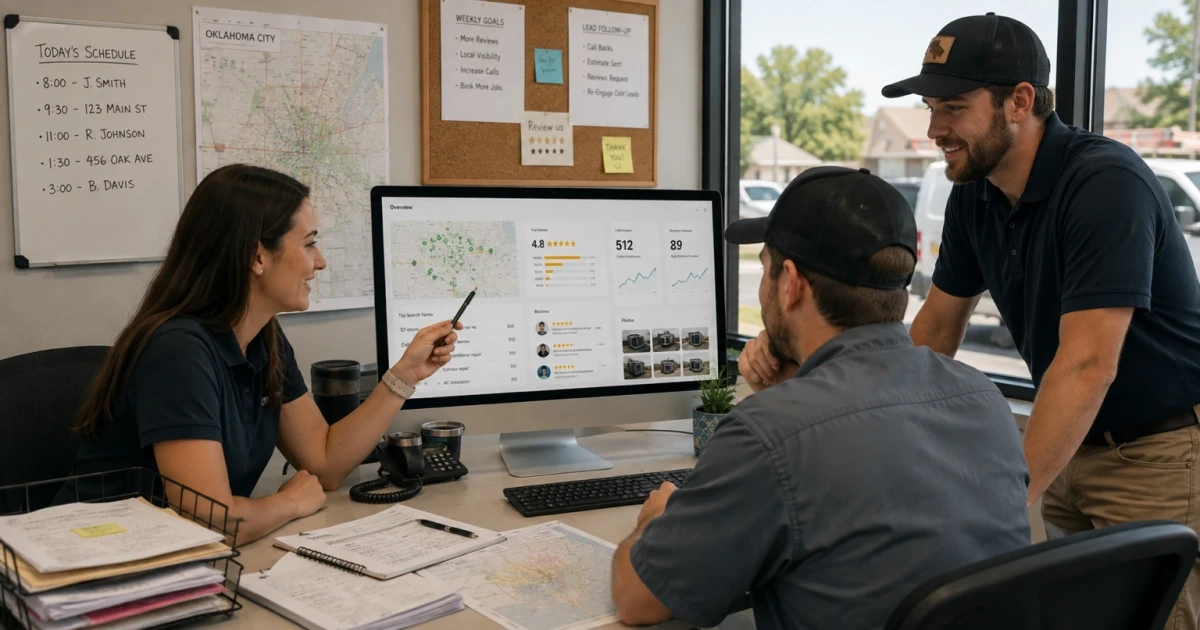
If you run a service business and you search local SEO Oklahoma City, you get two kinds of answers. One says everything changed because AI writes the results now. The other says nothing changed and you should keep buying the package you bought in 2019.
The honest version: AI answers changed the shape of the results page, not what makes a local business findable. A map result, a ten-link page, and an AI-written answer are fed by largely the same systems. Being clear, consistent, and easy to read still wins — and it matters more now, because there are fewer results on screen to be one of.
What Local SEO Oklahoma City Actually Means Now
Three surfaces decide whether a nearby customer finds you.
The map results. The short list of businesses with a map, ratings, and a call button. For most local service searches this is the highest-intent placement there is — the person is close, ready, and one tap from a phone call.
The organic results. The traditional links below. Still where research-stage searches land: what something costs, whether a repair is worth it, what to ask a contractor.
The AI answer. The summary at the top of the page, or the response from an assistant the customer asked instead of searching. It names businesses, drawing on profiles, maps, reviews, and pages it can read.
The third surface is fed by the first two. An assistant has no private database of Oklahoma City plumbers; it reads what is public. So the work below is not "old SEO" you do in addition to AI visibility — it is the AI visibility work.
Google Business Profile Is Still the Center of Gravity
For a local service business this is the highest-return item on the list, and it is free.
Claim it and fill it out completely. Get the primary category right — it is one of the strongest signals for which searches you appear in, and a vaguely-chosen category quietly costs you the ones that matter. Add the service areas you actually cover. Keep hours accurate. Post real photos of real work.
Then keep it alive. A profile untouched in two years reads as a business that may not still be operating — to a customer and to the ranking systems. Answer the questions people post on it. Update it when something genuinely changes.
The most common failure here is not neglect, it is inconsistency: an old address on the profile, a different one on the website, a third on a directory listing nobody remembers creating.
Reviews Are an Operations Problem Before They Are a Marketing One
Reviews affect where you show up and whether anyone calls after they find you. Every owner knows this. Almost nobody has a system for it.
The businesses with steady, recent reviews are not the ones with the best intentions. They are the ones where asking is built into the job — a request that goes out automatically when the work closes, at the moment the customer is most satisfied, without a person having to remember. That is a follow-up system, not a marketing tactic. If your follow-up is manual today, the reviews will be sporadic no matter how much you care; the same pattern that lets leads go cold is what keeps the review count flat.
Two things worth doing regardless of tooling: respond to every review, including the bad ones, in a calm and factual voice, and never gate or buy them. Review text is also read by AI assistants when they summarize a business — what your customers say in their own words is now part of how machines describe you.
Service Pages and Location Pages Still Do the Heavy Lifting
A homepage that lists nine services in a paragraph cannot rank for any of them. A page dedicated to one service can.
One page per service you actually want to sell. Say what the work involves, what moves the price, what a customer should expect, and what makes the job go badly when it goes badly. Write it the way you would explain it standing in someone's driveway.
Location pages follow the same rule with a stricter test: build one only where you can say something true and specific about doing the work there. Edmond, Norman, Moore, and Midwest City are different service realities — drive time, housing stock, the age of the systems you are working on. If a page still makes sense with the city name removed, it is a real page. If it collapses into filler, it was a template, and thin duplicated pages have been a liability for a long time.
Internal Linking Makes the Site Legible
Internal links are how you tell a crawler what your site is about and which pages you consider important. They are also the cheapest optimization available, because you already own every page involved.
Link from your homepage to your main service pages. Link between related services. Link from articles to the service page they naturally lead to. Use descriptive link text — "water heater replacement" rather than "click here" — because that text is one of the ways a machine decides what the destination covers.
The failure to look for is the orphan: a page with no links pointing at it. It exists, it may even be indexed, and it is treated as unimportant because nothing on your own site vouches for it.
Entity Clarity: Be One Consistent Business Everywhere
This is the part that has genuinely grown in importance, and the least discussed.
Search engines and AI assistants do not just index pages. They build a picture of a business as a thing — a name, a location, a set of services, a set of people. Anything that helps that picture resolve cleanly helps you get named in an answer.
In practice: the same business name, address, and phone number everywhere they appear. A real About page with real people. Consistent service naming instead of three different words for the same job. Structured data — the Schema.org markup that states in machine-readable terms that you are a local business, this is your address, these are your services — so nothing has to be inferred from prose.
When an assistant decides which Oklahoma City company to name for a specific job, it works from that picture. Ambiguity is what gets you left out, and it is usually self-inflicted.
Crawlable Structure: If a Machine Cannot Read It, It Cannot Cite You
None of the above matters if the site itself is hard to read.
The checklist is short and unglamorous. Every page returns real content on the first request, not a blank shell that fills in afterward. One clear heading per page describing what it is. A sitemap listing every page you want found. No accidental blocking in robots.txt. Pages that load fast on a phone using a truck's hotspot. Links that go where they say without bouncing through redirects.
This is boring, and it is where most local sites quietly lose. A beautiful site that renders nothing to a crawler is invisible regardless of how good the copy is. Same principle as the rest of the operation: the system has to be built around how the work actually runs, and the website is part of the system, not a brochure sitting beside it. Which of the features sold to bolt onto that website actually earn their place is a separate sort, and we ran it in AI website tools for small businesses in Oklahoma.
Where AEO and GEO Actually Fit
You will hear that SEO is dead and has been replaced by AEO — answer engine optimization — or GEO, generative engine optimization. Treat that framing carefully, because it is mostly being sold.
There is something real underneath. When an AI writes an answer it prefers content it can lift cleanly: a direct answer near the top of the page, questions phrased the way people actually ask them, short self-contained paragraphs, plain facts instead of build-up. Writing that way is a genuine discipline and it does help.
But it is a clarity layer on top of local SEO, not a substitute for it. No amount of answer-friendly structure gets a business cited if the profile is unclaimed, the reviews are three years old, and the service pages do not exist. Do the foundational work, then write clearly enough to be quoted. That order does not reverse. And nobody can promise you a specific placement in an AI answer — be skeptical of anyone who does.
What to Do First
If you only take one pass at this, in order:
- Claim and complete the Google Business Profile, with the correct primary category.
- Build a system that asks for a review after every completed job, automatically.
- Write one honest page for each service you want to sell.
- Link those pages from your homepage with descriptive text.
- Confirm your name, address, and phone number match everywhere they appear.
- Check that the site renders real content to a crawler and is listed in your sitemap.
Most of that is operational, not promotional — which is the point. LoGa is not a marketing agency, and this is not a pitch for a retainer. But the reason review counts stall and follow-up dies is almost never the marketing; it is that the work depends on somebody remembering. That is a systems problem, and it is the one we work on. Whether this list is one you should work yourself or hand to someone else is its own decision, and we drew that line in SEO company Oklahoma City vs DIY SEO. For the broader context, start with what an AI systems company actually does.
If you want a look at where your own front door is leaking — calls that go unanswered, quotes never followed up, reviews never asked for — see what we handle or book an audit.
Frequently asked questions
Does local SEO still work now that AI is answering search questions? Yes, because the AI answers are assembled from the same underlying sources. Assistants and AI overviews lean heavily on business profiles, map data, reviews, and pages that clearly state who a company is, what it does, and where it works. A business that is invisible to those sources is invisible to the answer. What has changed is that fewer searches end in a list of ten blue links, so the profile and the clarity of your pages carry more of the weight than they used to.
What is the single most important local SEO task for an Oklahoma City service business? Your Google Business Profile — claimed, complete, categorized correctly, and updated when something about the business changes. For most local service companies it is the first thing a searcher sees and the most common source of a direct call. Nothing else on this list pays back faster for the effort it takes.
Do I need a separate page for every city I serve? Only where you can write something genuinely different about working in that city. A real page names the neighborhoods, the response time, the local conditions, and the work you actually do there. If the only difference between two pages is the city name swapped in, they are duplicates with different headlines, and search engines have been discounting that pattern for years. Fewer honest pages beat a large set of thin ones.
How many reviews do I need to rank in the map pack? There is no threshold anyone can honestly quote, and any specific number you see should be treated as a guess. What is consistent is the direction: a steady stream of recent, detailed reviews, with owner responses, competes better than a stale block of old ones. Treat it as an ongoing operational habit rather than a target you hit once.
What is the difference between local SEO, AEO, and GEO? Local SEO is the whole practice of being found by nearby customers — profile, reviews, pages, links, and site health. AEO, answer engine optimization, is the narrower work of structuring content so it can be lifted cleanly into a direct answer. GEO, generative engine optimization, is the same idea aimed at AI assistants that write a response instead of listing results. In practice AEO and GEO are formatting and clarity disciplines layered on top of local SEO, not replacements for it.