What Is an AI Systems Company? A Plain-English Guide for Oklahoma Businesses
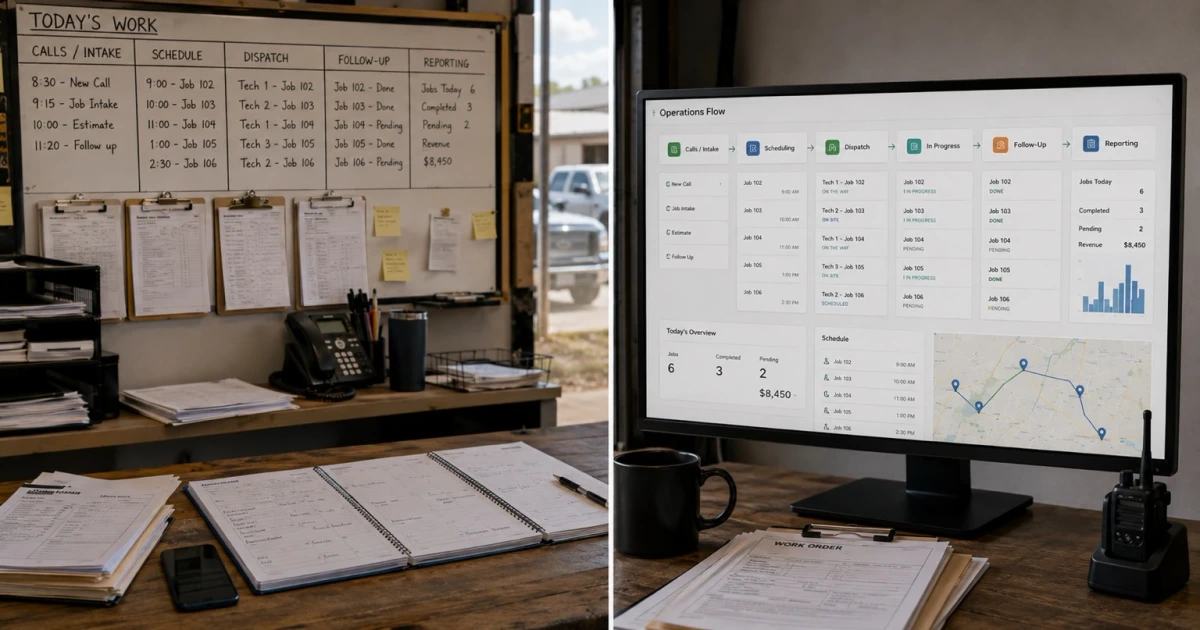
An AI systems company builds and connects the operating system a business runs on, then puts AI inside it where it actually helps. That's the short version, and the important word is systems, not AI. The work is less about adding intelligence and more about connecting the steps your business already moves through — the call, the intake, the routing, the follow-up, the report at the end of the week — so information stops falling into the gaps between them.
The term is new enough that it gets used loosely. Here's what it means in practice, and what it should mean before you pay anyone for it.
What Is an AI Systems Company, Exactly?
Picture how a job moves through your business today. A call comes in. Someone writes down what the customer needs. That gets to whoever handles it. It gets scheduled, done, invoiced. Somebody is supposed to follow up. At the end of the month, you try to answer how it all went.
Now notice how much of that path is held together by a person remembering to move something from one place to another. A note copied off a message pad into the calendar. A quote that went quiet and needs a nudge. A number you can only get by asking three people.
An AI systems company works on that path. It maps how the work actually moves, connects the steps so information carries forward on its own, and then adds AI at the specific points where a machine can genuinely do the job — answering the phone when nobody can, drafting the follow-up, sorting an inquiry to the right person, pulling the week's numbers into a screen instead of a scavenger hunt.
The deliverable isn't a feature. It's an operation where fewer things depend on someone remembering.
Why "Adding AI" Isn't the Same Thing
Plenty of businesses have already added AI. There's a chatbot on the website. Someone on the team drafts emails with it. Maybe the phone system has a voice option now.
That's adding AI. It rarely changes how the business runs, for a simple reason: each piece is blind to everything on either side of it. The chatbot has a good conversation, then that conversation ends inside the chat widget. The voicemail transcription is accurate and lands in an inbox nobody triages on Saturday. The drafted follow-up is well-written and still requires a person to remember to send it.
None of that is wasted, exactly. It just doesn't compound, because the gaps between steps were the problem and none of it touched the gaps.
A system is the opposite arrangement. The AI that answers the call already knows your services and hours, and what it captures goes straight into the same place the rest of the job lives. The follow-up fires because the job reached a stage, not because someone remembered. The report at the end of the week is built from the work itself instead of assembled by hand. Same technology, connected — which is the whole difference. It's the same argument we make in why a pile of tools isn't a system.
The Six Things an AI System Connects
Almost every service business runs the same skeleton, whatever the trade. A real system covers all six of these, even if it only automates a couple at the start.
Intake. Getting the request in cleanly, from wherever it arrives — a call, a form, a text, a referral. Nothing downstream works if the front door is a message pad and three inboxes. This is where an AI call answering system handles what comes before, during, and after the call.
Routing. Deciding where the request goes and who owns it next. Emergency versus routine, new customer versus existing, in your service area versus not. Routing is the step that decides whether a request waits three minutes or three days.
Data. One place where the customer, the job, and the history actually live. Not three tools with three half-versions of the same record. This is usually the least exciting part of a build and the one everything else depends on.
Follow-up. The quote that went quiet. The maintenance due in six months. The customer who said "call me next week." Follow-up is the most commonly dropped step in a service business, because it's the one with no deadline attached.
Reporting. Knowing what happened without a scavenger hunt — how many jobs, what closed, what stalled, where time went. Reporting built from the system is trustworthy; reporting assembled by hand at month-end mostly isn't.
Human handoff. The point where the system stops and a person takes over: judgment calls, pricing exceptions, an unhappy customer, anything unusual. This is a designed part of the system, not a failure of it. A system that never hands off is a system that will eventually give a confident wrong answer to someone who deserved a real one.
The value isn't in any single one of those. It's in the handoffs between them holding without a person carrying the information across.
What the Work Actually Looks Like
The order matters more than the tooling, and it is the same order every time — the short version is on how it works.
It starts with mapping how the business runs today — in your words, not a vendor's. Where jobs stall, what gets typed twice, which question takes a phone call to answer.
Then it connects what's already there. Tools that genuinely fit how you work can usually stay and be wired together through their APIs, so the data moves without anyone retyping it. Replacing a working stack on day one is rarely the right first move; that's the plain-English version of what integration actually is.
Then AI goes in at the specific points where it earns its place — with guardrails, and with a defined handoff back to a person.
And it ships in pieces. One handoff closed, proven through a real busy week, then the next. A first build should be small enough to pay for itself before the second piece starts. The longer version of this sequencing is in how to build the software system around your service business.
What This Looks Like for an Oklahoma Business
Most of the companies we work with in Oklahoma City and around the state are service businesses — trades, home services, field work, local operations with a handful to a few dozen people. The pattern is consistent: the business is good at the work and losing money in the handoffs around it.
Being local matters less for the technology than for the mapping. The map has to come from how your shop runs — your crew size, your customers, your busy season, the corrections you've made over a decade that nobody wrote down. That's an in-person conversation, not a form. It's also why we don't start with a product demo; we start by walking the workflow. More on who LoGa is and how the company got here is on our company page.
If you're weighing whether you've outgrown what you have, the honest signals are in when a spreadsheet stops being enough. The same hire-it-or-do-it-yourself question, applied to search specifically, is in SEO company Oklahoma City vs DIY SEO.
What to Ask Before You Hire One
Five questions worth asking any AI systems company, including us:
- What are you connecting, not just adding? If the answer is a single feature, it's a tool, not a system.
- Where does the AI hand off to a person, and how does that person get the context?
- What happens when it's wrong? Every system is sometimes wrong. Ask what the failure looks like from the customer's side.
- What's the smallest first piece, and what does it cost? A build that can't be scoped small is a build that hasn't been understood yet.
- Who owns it afterward? Systems need maintenance. Ask who does it and what that costs before you're depending on it.
An AI systems company should be able to answer all five without a slide deck. If the conversation stays on the technology and never reaches your workflow, it's the wrong conversation.
That's the work at LoGa AI Systems: mapping how a service business actually runs, then building the connected system around it — intake through reporting, with AI where it helps and a person where it should be.
Frequently asked questions
What is an AI systems company? It's a company that connects the steps your business already runs — intake, routing, data, follow-up, reporting, and the handoff back to a person — into one system, and uses AI only at the points where it genuinely helps. The deliverable is a connected operation, not a chatbot bolted onto a website.
How is an AI systems company different from an AI tool or an agency? A tool solves one step and stops at its own edges. An agency usually markets or advises. An AI systems company works on the connections between steps — the handoffs where jobs actually stall — and is responsible for whether the whole path holds up on a busy week, not whether one feature demos well.
Do I need AI to fix my workflow, or just better software? Often just better connections. Most of what breaks in a service business is information not moving: the same detail typed twice, a lead nobody followed up on, a job status that lives in one person's head. Wiring those together is ordinary software work. AI earns its place in the narrower spots — answering a call at 7pm, drafting a follow-up, summarizing what a customer said — after the path underneath it is solid.
What should an AI system hand off to a person? Anything involving judgment, money, or an unhappy customer. Pricing exceptions, angry callers, safety issues, anything unusual enough that a confident wrong answer costs more than a slow right one. A well-built system knows what it doesn't know, hands those off with the full context attached, and tells someone it did.
How does a small Oklahoma business start with AI systems without a big project? Start at the single handoff leaking the most time or money — usually missed calls or slow quote follow-up — and close only that one. Prove it holds through a real busy week, then widen. A first build should be small enough to pay for itself before the second piece starts.