How to Automate Your Business With AI: Build a System, Not a Pile of Tools
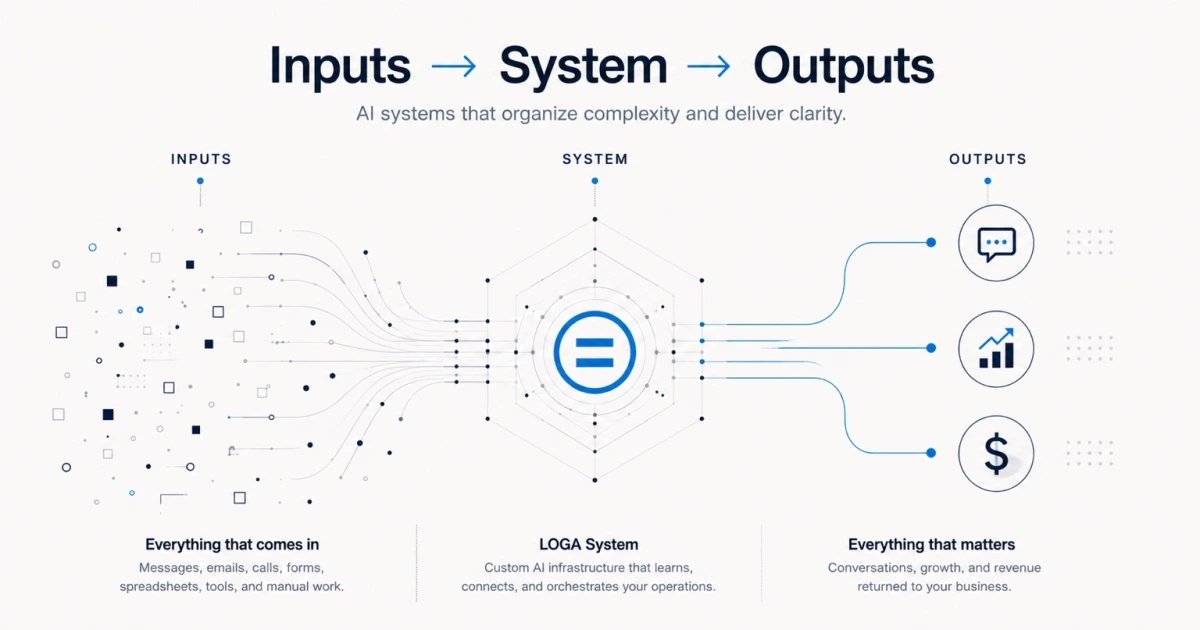
"I should be using AI" creates more stress than it removes. If you have been trying to work out how to automate your business with AI, that stress is usually where the question stalls. You picture chatbots and a dozen new apps to babysit, and you go back to the work that's actually piling up. Adoption has quietly become the norm, though: the U.S. Chamber of Commerce found that 58% of small businesses now use generative AI, up from 40% a year earlier — so you're not behind for wondering where to start. Here's the reframe that makes it simple: the goal isn't to collect AI tools. It's to have one system that runs your work for you — with AI quietly handling the parts it's genuinely good at, inside that system. You don't build it; that's the part a company like LoGa builds for you.
A tool does a task. A system runs the work.
A single AI tool answers a question or drafts a message. Useful — but it's still one more thing you have to operate. A system is how the work moves on its own. Say a customer fills out your contact form. Right now you re-type their details into three places by hand. A system does that once, the same way every time — and AI is just one small part working inside it, not another gadget to manage.
A real example
A dental front desk used to copy every new patient into the scheduler, the chart, and the reminder list — three times, by hand, between patients. With a system, the patient fills out one form: the chart is created, the recall reminder is queued for six months out, and the review request is ready to send, before the next patient sits down. Same staff, far less re-typing, nothing slipping.
What should you automate first?
Start with the task that's repetitive, predictable, and constant — that's where automation pays. The best first candidates are the boring, every-day handoffs:
- Turning a finished job into an invoice and a review request.
- Making sure a new lead gets a response before it goes cold.
- Moving a new customer's details into every place they need to live — once, instead of three times by hand.
None of those is glamorous, and that's the point: they happen constantly, and a system should carry them for you.
Which AI tool is best for a small business?
The honest answer: the best tool is the one that fits the task in front of you. The bigger win is the system that connects them — so they stop being five subscriptions that don't talk to each other. Chasing "the best AI tool" in the abstract is how owners end up with more logins and more chaos than they started with.
Why not just duct-tape some tools together yourself?
You can, for simple things — and for a weekend it feels great. The trouble starts when your business doesn't run like the tool assumed: an exception it can't handle, a step that needs judgment, a connection that quietly breaks. A custom system is built around how you actually work, including the messy parts, so it holds up on a busy Monday instead of only in a demo. It's a build, not a download — but you start with one task, not a year-long project.
How to Automate Your Business With AI Without Blowing Up What Works
Start small and prove it before you scale:
- Pick one task — the same boring handoff, every time.
- Check its work at first, until it earns your trust.
- Get it running reliably, then add the next.
It should make the day calmer, not riskier: if it adds steps or anxiety, it's the wrong move.
Done this way, the payoff is real: Salesforce found that 91% of small and medium businesses using AI say it boosts their revenue — but that comes from one reliable task at a time, not a dozen half-configured tools.
You don't need to figure out AI. You need one task taken off your plate, done the same way every time — then another. That's how the work stops living in your head.
If you want a straight read on which task to start with, that is what a systems audit is for.
Frequently asked questions
How do I automate my business with AI? The goal isn't to collect AI tools — it's to have one system that runs your work for you, with AI quietly handling the parts it's genuinely good at inside that system. You don't build it; a company like LoGa builds it for you. Start with one repetitive task, get it running reliably, then add the next.
What should I automate first? Start with the task that's repetitive, predictable, and constant — that's where it pays. Turning a finished job into an invoice and a review request, or making sure a new lead gets a response before it goes cold. The boring, every-day handoffs are exactly what a system should carry for you.
What's the best AI tool for a small business? The best tool is the one that fits the task in front of you. The bigger win is the system that connects them, so they stop being separate subscriptions that don't talk to each other. Chasing "the best AI tool" in the abstract is how owners end up with more logins and more chaos than they started with.
Is a custom software system better than a pile of AI tools? A single tool does one task and is still one more thing you have to operate; a system is how the work moves on its own. A custom system is built around how you actually work, including the messy parts, so it holds up on a busy Monday instead of only in a demo. It's a build, not a download — but you start with one task, not a year-long project.
How do I start automating without breaking what already works? Begin with one task — the same boring handoff, every time — and check its work until it earns your trust. It should make the day calmer, not riskier: if it adds steps or anxiety, it's the wrong move. Get one thing running reliably, then add the next.